Where AI actually saves time in cloud operations
AI tools made reading telemetry, summarising changes and drafting config cheap. Deciding what to do with a misbehaving system, and owning the result, costs what it always did.

Ask a vendor what AI does for operations and you get a story about headcount.
The tools read logs now, so you need fewer engineers, so running your systems gets cheaper. Part of that story is true.
The part it gets wrong is which half of the job was actually expensive.
Reading the logs was never the expensive half.
Deciding what to do about what the logs say, at an awkward hour, with real customers attached, and then living with that decision... that is the expensive half, and it has barely moved.
There is a line running through operations work. On one side, AI really did make things cheaper.
On the other, almost nothing changed.
By the end of this you should be able to put your own team's tasks on the right side of that line, and spot the mistake that makes a team feel faster while it gets more fragile.
The work that really did get cheaper
Start with a Tuesday morning. Something is slow, you have four accounts and a wall of dashboards, and nobody knows where to look first. Twenty minutes of your life disappear into scrolling.
That kind of work has a name. The Google SRE book calls it toil: manual, repetitive work that grows as your system grows and leaves nothing behind when you finish it. Think of emptying the dishwasher. Necessary, endless, and nobody is a better cook for having done it.
Toil is exactly what these tools are good at, and five kinds of it got noticeably cheaper.
Reading telemetry. Telemetry just means the stream of measurements your systems emit about themselves: logs, metrics, events. Finding the one line that matters among thousands used to be the slow part of an incident. CloudWatch investigations reads across metrics, logs, deployments and configuration changes, then offers you some guesses at the cause. You accept them or throw them out.
Meta published numbers on its own version of this. Their system put the real culprit somewhere in its top five suggestions in 42% of investigations. It is measured fairly, by replaying old incidents with only the information available at the time.
Sit with that figure for a second, since it cuts both ways. Getting into the top five two times out of five is useful; it points you at a neighbourhood instead of a city. It also means that most of the time the first suggestion is wrong. The only thing standing between a wrong guess and production is an engineer who can tell. Microsoft researchers have reported the same shape of result, helpful but not decisive.
Knowing what changed. The Google SRE book notes that roughly 70% of outages come from a change someone made to a running system. That is the single most useful number in this article. It means the answer to "why is it broken?" is usually "because of something we did", so the fastest route to a fix is a reliable diff of your own recent behaviour.
Getting that diff used to mean clicking through accounts for an hour. Point a model at AWS Config history and CloudTrail Lake, which between them record what your resources looked like over time and who touched them, and you get a readable summary in minutes. If you try one thing from this article, try this one.
First drafts. A permissions policy, a change to an infrastructure module, a rollback script. What comes back in seconds is coherent and usually close. Starting from something beats starting from an empty file, the same way an outline beats a blank page.
Documentation nobody ever wrote. Most teams have a system that lives in one person's head. Writing it down was always a project nobody would fund. Now you generate a first description from the live configuration, have the person who knows it correct the embarrassing bits, and you are done in an afternoon. Google's 2024 DORA report found this was where AI adoption helped most.
Sorting alerts. When fifteen alarms fire at once, putting them in order of likely importance is pattern matching, and it helps most at 3 a.m., when the human reading them is at their worst. CloudWatch anomaly detection did a version of this before anyone said "LLM". The new part is that the summary arrives in plain English.
Notice what these have in common. Every one was expensive because it was tedious at scale, and tedium at scale is the one thing software has always been better at than us.
The work that did not budge
Now a different Tuesday. The fix is understood, it needs a restart, and the restart drops traffic for four minutes. Do you do it now, with support staffed and customers watching, or at 2 a.m. on Saturday with one tired engineer and nobody to escalate to?
No dashboard answers that. It depends on your revenue pattern, your contract terms, which account is up for renewal, and how badly the last unplanned restart went. None of that is in the telemetry. It is a business question wearing an engineering costume, and three more of the hardest parts of operations look just like it.
- Knowing why things are the way they are. An alert fires every Tuesday and means nothing, because of a retry setting someone picked eighteen months ago for a reason they never wrote down. A model reading your config can tell you what is true. It cannot tell you what was deliberate.
- Owning the outcome. When a call goes badly, a person explains it to the customer, writes the postmortem and changes how the team works. A tool has nothing at stake. Accountability is not a task you can hand off, since it was never a task.
- Fitting the answer to the business. The better architecture is often the wrong one for a six-person company, since it needs people they do not have. Much of what a senior engineer contributes in a planning meeting is talking everyone out of things.
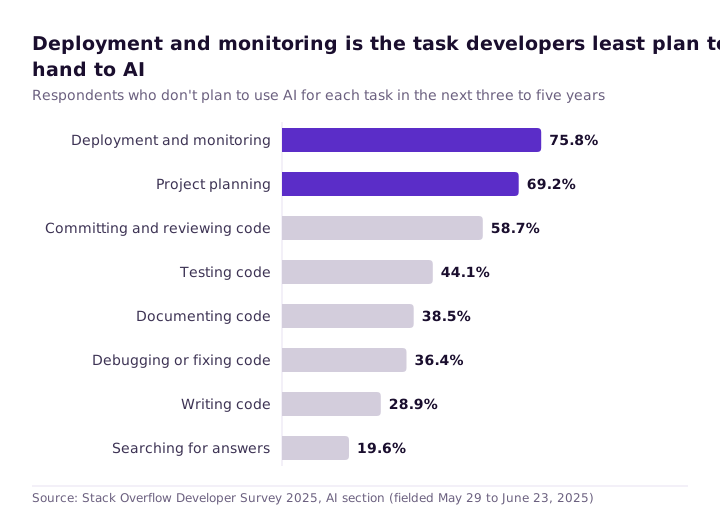
Developers appear to know exactly where this line sits. In the 2025 Stack Overflow Developer Survey, deployment and monitoring was the area where the most people said they had no plans to use AI at all.
Why "almost right" costs more than "wrong"
One failure catches good teams.
A generated config change that is obviously broken is harmless. It fails review, someone laughs, you move on. The dangerous one is the change that is nearly perfect, like a permissions policy that grants a little more than it should, phrased exactly the way a correct policy is phrased. It reads fine. It gets merged. It sits there.
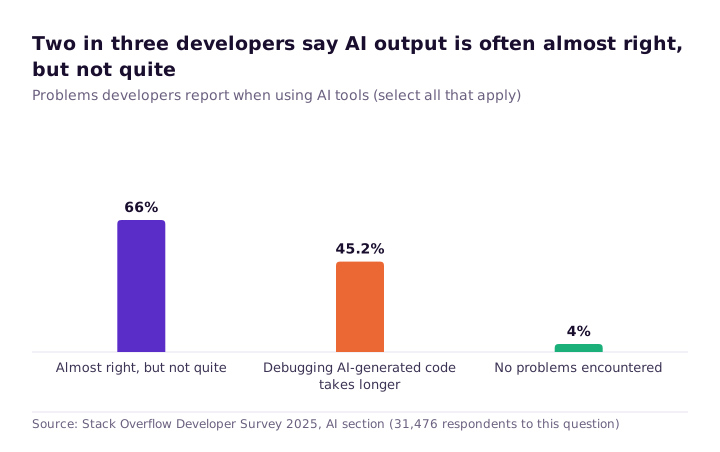
Developers in that same survey named this as their number one complaint.
Two studies suggest this is hard to feel from the inside. In a randomised trial run by METR, experienced open-source developers took 19% longer on their tasks when AI tools were allowed. Afterwards, those same developers estimated they had been about 20% faster.
Pause on that pair, since it is the most uncomfortable thing here. The measured result and the felt result point in opposite directions by roughly the same margin. METR has since said those early-2025 numbers are out of date, and they published newer data, so do not treat the slowdown as a law of nature. Treat the gap as a warning, since "this feels faster" is not evidence that it is.
The 2024 DORA report found something consistent. As AI adoption went up, documentation and code review got better, while delivery stability got slightly worse. The review work did not vanish. It became the job.
The ledger
| Task | Who does it now | What changed |
|---|---|---|
| Finding the anomaly in logs, metrics and events | Tool reads, engineer judges | Hours became minutes |
| Summarising changes between two dates | Tool, with spot checks against Config and CloudTrail | Painful became routine |
| First draft of a policy, module or script | Tool drafts, engineer rewrites and approves | Typing is cheap; review is the cost |
| Documenting undocumented systems | Tool drafts from live config, owner corrects | Unfunded became an afternoon |
| Ranking a burst of alerts | Tool ranks, engineer confirms | Better than a tired human at 3 a.m. |
| Choosing a maintenance window | Engineer who knows the business | Nothing |
| Knowing which oddities are deliberate | Engineer with the history | Nothing |
| Owning the call when it goes wrong | A named person | Nothing |
Read down the right-hand column and the pattern is hard to miss. The savings are all in the preparation. The cost is all in the decision, and the decision still needs a person who knows your business.
So the realistic upside is the same engineers covering more ground with much better information, rather than a smaller team. A company that drops its senior people because a tool can summarise logs has not cut cost. It has moved the 2 a.m. decision to someone without the context to make it, and that bill arrives later.
How to set the tools up so they actually help
A few rules I would hold to, whatever you end up buying.
- Treat every claim as a hypothesis. Anything a tool tells you about your environment is unconfirmed until a person checks it against the live system. These tools sound exactly as confident when they are wrong.
- Read widely, act narrowly. Let the tool look at everything. Give it its own identity with its own permissions, log every action it takes, and require a human to approve anything that touches production.
- Prefer tools that show their evidence. "The cause is X" is a claim. "The cause is X, and these are the log lines and the deploy that made me think so" is something you can check in thirty seconds.
- Reward silence. Meta's write-up describes holding back low-confidence suggestions rather than offering them, trading coverage for accuracy. For anything that reaches a sleepy on-call engineer, that is the right trade.
What you could try this week
Pick the single most tedious recurring thing your team does. The weekly "what changed" trawl, Monday morning alert triage, or writing down the one system that lives in one person's head.
Hand the reading and the first draft to a tool. Keep the decision with a named engineer. Then time both halves over a few runs, since the ratio between them is what you need to know, and nobody can tell you what it is for your team.
After that, go and look at your on-call rota and ask a quieter question: who actually makes the call when the next incident lands at a bad hour? If the answer is one person, and that person could take another job next month, that gap will cost you more than any tool is going to save you.